How to Localise a Corporate Video for Asia with AI: Languages, Voice and Markets
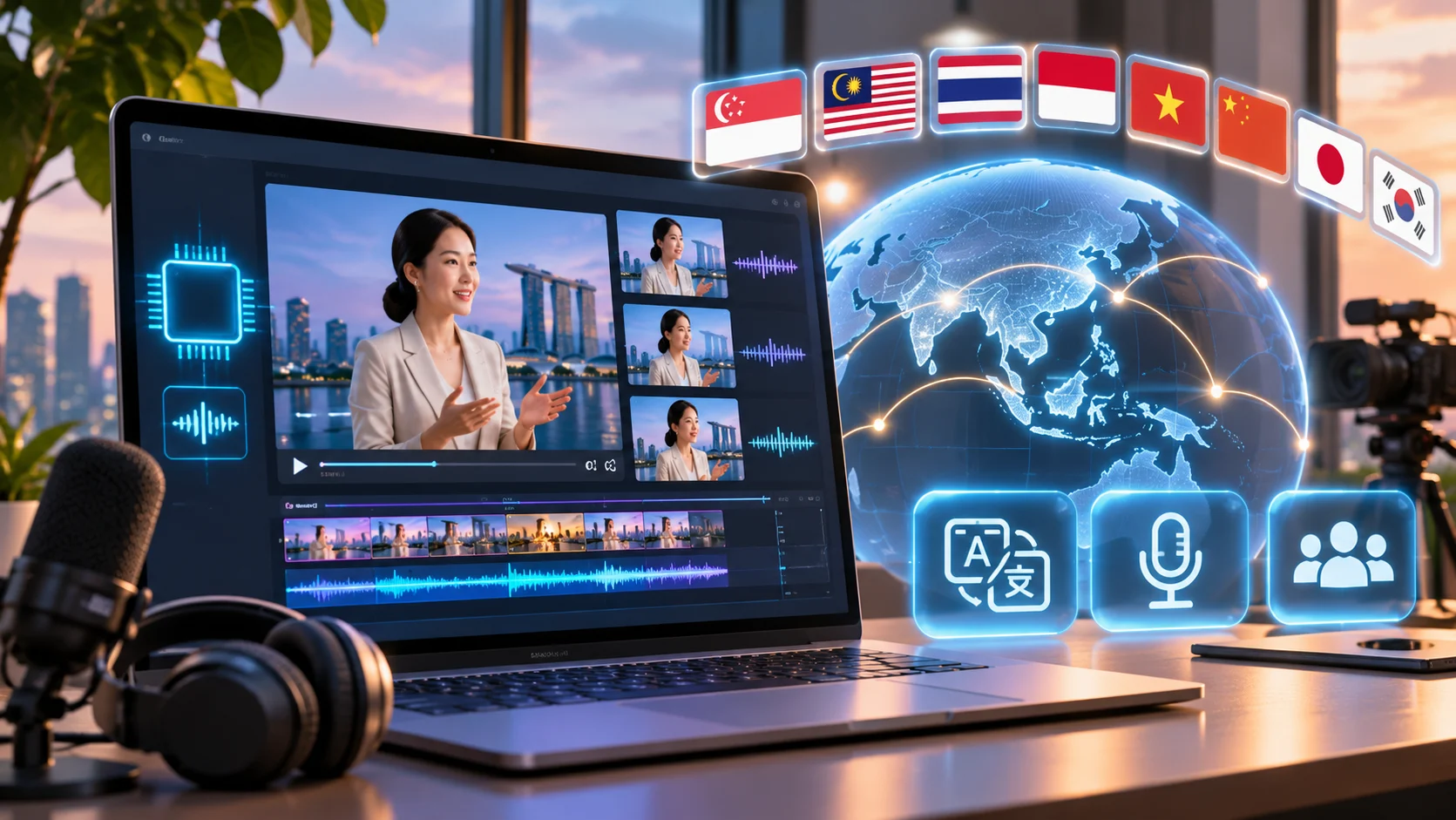
Yes, one video can be adapted for several Asian markets with AI: translated script, new voiceover, subtitles and localised on-screen text. AI makes the work faster and cheaper than re-recording each version. Quality still depends on a native-speaker review, because tone, humour and local terms are where AI translation most often goes wrong.
I’m Joshua Lim, a Malaysia-based producer and filmmaker with 15+ years in production. I make AI and hybrid videos for brands and agencies in Malaysia, Singapore and the region, and I can deliver English, Chinese and Cantonese versions. This guide explains what localisation includes, how it works, and how to plan it.
Do you need multiple language versions for APAC?
It depends on where your audience is.
| Market | Languages commonly needed | Note |
|---|---|---|
| Singapore | English, Mandarin, Malay, Tamil | English works for most business audiences. Add Mandarin for consumer and community campaigns. |
| Malaysia | English, Malay, Mandarin, Cantonese | Mix depends on audience and industry. |
| Hong Kong | Cantonese, Traditional Chinese, English | Written Chinese is Traditional, and spoken is Cantonese. |
| Taiwan | Mandarin, Traditional Chinese | Vocabulary differs from Singapore and Malaysia. |
| Indonesia | Bahasa Indonesia, English | Bahasa Indonesia is not the same as Malay in tone and vocabulary. |
For a regional corporate audience, English with subtitles is often enough. For consumer, recruitment and community campaigns, a spoken local-language version is usually more effective.
What does video localisation include?
- Script translation and adaptation. Rewriting for the local audience, not only converting words.
- Voiceover. A new voice in each language, either a real voice artist or an AI voice.
- Subtitles and captions. Translated, timed and checked.
- On-screen text. Titles, lower thirds, prices, call-to-action and legal lines.
- Visual changes. Symbols, colours, dress, numbers and examples that suit each market.
- Lip-sync, when people speak on camera. Optional, and not always worth the cost.
- Quality review. A native speaker checks each version.
How AI helps
- Speed. A script can be translated and a voiceover produced in hours or days, not weeks.
- Cost. Re-recording with new talent in every language is avoided.
- Consistency. The same visuals and timing are reused, and only language elements change.
- Scale. Adding another language later is far cheaper than making a new film.
One Singapore production guide estimates that each additional language adds roughly 30% to 60% of the base editing cost, depending on whether you use voiceover or subtitles. Subtitles alone typically cost around SGD 200 to 500 per language.
Where AI localisation goes wrong
- Tone and humour. Literal translation can sound stiff or wrong.
- Local words. Names, places, Singlish, Manglish and code-switching often need manual correction.
- Malay and Tamil voices. AI speech can lack natural rhythm. Have a native speaker listen before release.
- Text expansion. Some languages need more space on screen and a different timing.
- Cultural fit. Colours, numbers, gestures and examples can mean different things between markets.
Plan a native review for every language, and give the reviewer the video, not only the script.
Voice cloning and consent
If you clone a real person’s voice, such as your CEO or spokesperson, get written consent first. State where the voice will be used, for how long and in which languages. If a voice or presenter is AI-generated and might be mistaken for a real person, say so.
Subtitles, AI voice or real voice artist?
| Option | Best for | Trade-off |
|---|---|---|
| Subtitles only | Regional corporate and B2B audiences who understand English | Lowest cost, but less engagement for consumer audiences |
| AI voiceover | Explainers, internal training, social content, many languages | Needs native review, especially for Malay and Tamil |
| Real voice artist | Brand films, flagship campaigns, emotional stories | Higher cost and time per language |
| Hybrid | Key languages with a real voice, the rest with AI | Balanced cost and quality |
A simple localisation plan
- Choose markets and languages based on where your customers are, not on every possible market.
- Finish the master video first. Lock the picture before translating.
- Write the script with translation in mind. Short sentences, no slang, and space for text growth.
- Translate, then adapt. Have a native speaker polish the script.
- Produce voice and subtitles for each language.
- Review each version with a native speaker before release.
- Deliver versions named by language and platform, with subtitle files.
Frequently asked questions
Can a video be localised for different Asian markets with AI? Yes. AI can translate the script, generate the voiceover and prepare subtitles for each market. A native-speaker review is still needed to keep the tone natural.
Do I need separate videos for Singapore, Malaysia and Hong Kong? Not always. English with subtitles often works for business audiences. Use separate language versions for consumer campaigns and for markets such as Hong Kong, where written and spoken Chinese differ from Singapore and Malaysia.
How much does it cost to add another language? One Singapore guide estimates 30% to 60% of the base editing cost per additional language, and around SGD 200 to 500 per language for subtitles. A fixed quote depends on length and the number of languages.
Can AI clone our spokesperson’s voice in other languages? It can, with written consent. The voice should be checked by a native speaker, and AI voices should be disclosed where viewers could think they are real.
Which languages can you deliver? English, Chinese and Cantonese. For other languages, I work with a native reviewer to check the result.
How long does localising a video take? A short video can often be localised in a few days per language. Native review and client approval usually take longer than the AI work.
Planning a regional campaign? Send me your markets and languages. Discuss Your Project
Corporate video production in Malaysia → · AI video production in Malaysia → · AI video production across Asia →